
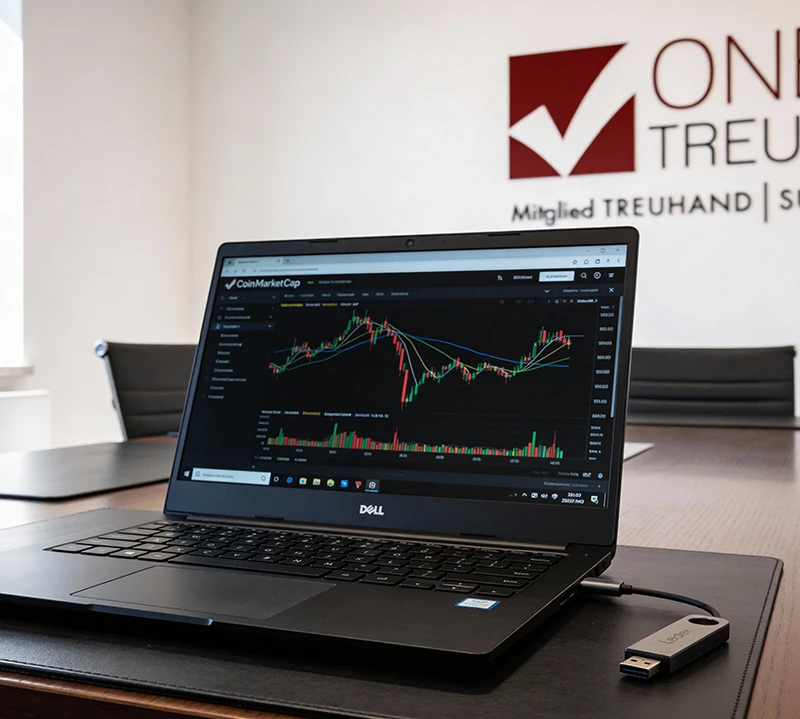
Tax consulting and support for cryptocurrencies
Anyone who owns cryptocurrencies such as Bitcoin, Ethereum, or Cardano (ADA), etc., is also required to pay taxes on them.
In principle, cryptocurrencies are classified as assets and are declared in the securities and assets register. As such, they are subject to wealth tax. However, there is also the possibility that they fall under income tax (mining, staking rewards, lending rewards, yield farming, etc.).
To make the taxation of cryptocurrencies easier for you, we are happy to take care of this task on your behalf. We declare your cryptocurrencies correctly, help you avoid incorrect entries, and can thereby also reduce your tax burden.
Rodolfo Intaglietta – federally certified trust expert
The initial consultation is non-binding – you decide calmly afterwards.

Trading, Staking, Mining
Professional handling of cryptocurrency taxation
The taxation of cryptocurrencies is one of the most complex and fastest-growing areas of Swiss tax law. Whether trading, staking, mining, NFTs, or DeFi – every transaction can have tax implications that are easily overlooked without professional support.
Our specialized crypto tax consulting ensures that your digital assets are correctly declared, optimally valued, and fully integrated into your tax return.
This helps you avoid risks, create transparency, and make full use of all tax opportunities available to you.
- Declaration of cryptocurrencies: Correct recording and reporting of all digital assets
- Cryptocurrencies & tax returns: Full integration of crypto holdings, wallets, and transactions into the tax return
- Integration into wealth tax: Valuation of coins, tokens, and NFTs in accordance with cantonal guidelines
- Transaction analysis: Preparation and analysis of trades, swaps, staking rewards, airdrops, and mining income
- Profit and loss calculation: Tax‑compliant calculation of realized gains and losses
- Staking, lending & mining: Tax treatment of income from staking, liquidity pools, mining, and DeFi protocols
- NFT taxation: Valuation, declaration, and tax classification of NFTs
- Crypto documentation: Preparation of audit‑proof documentation for tax authorities
- International crypto matters: Consulting on foreign exchanges, wallets, and cross‑border transactions
- Corrections & subsequent declarations: Support with missing or incorrect crypto declarations from previous years
- Support with tax inquiries: Assistance with questions from tax authorities regarding crypto transactions
- Tax optimization for crypto investors: Strategic planning to minimize the tax burden within the legal framework



Digital, simple, effective – this is how our trust app works
Simply scan your receipts via app or upload them directly. Your data is securely transferred to our system, we handle the processing, and you retain a clear overview of your figures at all times.
This finally makes accounting, taxes, and payroll simple, transparent, and efficient.
- Capture receipts digitally – no more paper
- Access figures at any time – full transparency
- No accounting knowledge required – we take care of everything
- Secure data transmission – according to Swiss standards
No commitment, no risk – see for yourself how much time you save!
Customer feedback
Our digital fiduciary services are used by more than 300 SMEs in Zurich, throughout Switzerland and internationally – reliably managed, clearly structured, and personally supported.

„ONE! Treuhand reviewed my personal tax situation thoroughly and explained everything clearly. I finally have clarity and make financial decisions with confidence.“
Loreen

„I simply upload my documents and everything is taken care of. My tax return is accurate, on time, and saves me a lot of effort every year.“
Urs

„My crypto transactions were prepared correctly and declared properly. What I appreciated most was the clear explanation of what is tax-relevant and what is not.“
Tim
4 SIMPLE STEPS
Your path to competent crypto tax consulting
Crypto transactions are complex, diverse, and tax-intensive. Our structured process ensures that your wallets, trades, and income are correctly recorded, optimally valued, and fully tax-compliant – simple, transparent, and stress-free.
Direct, clear, without detours – and always traceable crypto tax optimization
Guarantee & freedom from risk
You remain flexible: There is no minimum term and no notice period. If you ever find that we are not the right fit for you, simply end the collaboration – uncomplicated and at any time.
With us, there is no long back and forth, but fair, clear conditions. It is important to us that you are truly convinced. We want to give you security so that you can fully focus on what matters most: your business.
Our quality promise
We are a member of TreuhandSuisse – the leading professional association for trustees in Switzerland. Membership is only possible with sound professional training and guarantees that you will always work with professionals.
We consistently invest in further training
Every year we complete mandatory training courses and workshops – this is strictly monitored by TreuhandSuisse. This ensures we are always up-to-date in taxation, accounting, business consulting, and much more.
Real security through professional liability insurance
We have comprehensive professional liability insurance (mandatory for members of TreuhandSuisse). Should an error occur that causes damage, you, as our client, are protected without financial disadvantage.
The ONE! Knowledge Base on crypto and taxes
Relevant information, ongoing updates, and always clearly explained!


Taxing cryptocurrencies correctly – the FAQ
So that you know exactly what to expect, we have compiled the most important questions about the taxation of cryptocurrencies – based on the concerns we receive daily from companies and private individuals in Zurich and throughout Switzerland.
What is a cryptocurrency?
A cryptocurrency is a purely digital currency. Physical banknotes or coins do not exist. Alternative terms include cyber currency or crypto money.
The main difference between a cryptocurrency and conventional means of payment is that digital currencies are not controlled or issued by a government or central bank. Instead, they are decentralized and organized by private individuals, legal entities, or third parties who hold units of the respective cryptocurrency.
What is a blockchain?
For cryptocurrencies to function, all transactions must be encrypted, verified, and stored. The capacity of a conventional database is not sufficient for this. In addition, traditional databases are susceptible to manipulation.
To provide sufficient computing power and maximum security for complex digital currencies, cryptocurrencies require a decentralized database. This means that the same database state is distributed across multiple computers, making hacking significantly more difficult than with a centralized database. In this decentralized database, all transactions are permanently and transparently stored in data blocks.
Once a data block is full, a new block is added. This block contains information referring to the previous block. Over time, these data sets form a chain of many individual blocks – this is how the blockchain is created.
How are cryptocurrencies taxed?
In principle, cryptocurrencies in the form of payment tokens are classified as assets and are declared in the securities and assets register. As such, they are subject to wealth tax. They must be declared at the end of the tax period (generally December 31) at their market value.
However, cryptocurrencies may also fall under income tax. This includes income from cryptocurrencies such as mining, staking, lending, or operating masternodes.
Since common wallets and crypto exchanges rarely (if ever) provide tax documents for income and asset positions that can be used directly for tax returns, it is recommended to keep your own transparent and traceable records, which can then be attached to the tax return.
Capital gains are generally tax-free (tax-free capital gains).
For commercial trading, commercial mining (proof-of-work), commercial operation of staking pools (proof-of-stake), or similar activities, this can result in taxable income from self-employed activity even for natural persons.
Make sure your crypto remains profitable!
Start with a non-binding initial consultation and get to know ONE! Treuhand personally.
- Save time through digital processes
- Save money through a clean tax structure
- Maintain security through qualified professionals
- Personal contact person instead of a hotline

Rodolfo Intaglietta | CEO
Eidg. diplomierter Treuhandexperte &
Diplomierter Experte in Rechnungslegung und Controlling
Standort: Zürich-Glattbrugg
Mail: welcome@onetreuhand.ch
Phone: +41 (0) 44 533 34 25