WhatsApp

+41445333425

Telefon

+41 (0) 44 533 34 25

Email

welcome@onetreuhand.ch

+41 (0) 44 533 34 25

welcome@onetreuhand.ch

×

Tax Deductions for Companies in Switzerland

Targeted tax deductions help companies reduce their tax burden, support investments, and create financial flexibility.

12.01.2024 von Rodolfo Intaglietta EN
Letzte Aktualisierung: 03.02.2026
informations
Advanced
12 Min

Companies in Switzerland can use various tax deductions to reduce taxable profit and, in some cases, capital tax. Key deductions include operating expenses, depreciation, research and development costs, and investment deductions. Proper documentation is essential to claim deductions correctly.

What you will learn:

  • Basics of corporate taxation in Switzerland
  • Key tax deductions for companies and their application
  • Distinction between operating expenses, depreciation, and investments
  • Special rules for SMEs, start-ups, and international companies
  • Documentation and evidence required for tax returns

Required skilllevel

Advanced knowledge required

Required Tools

  • System for organising receipts and contracts (digital or physical)
  • Accounting software or structured bookkeeping with document archiving
  • Overview of investments, assets, and depreciation schedules
  • Documentation for R&D projects and external services

Basics of Corporate Taxation in Switzerland

In Switzerland, companies are primarily subject to profit tax on their earnings and capital tax on equity. Tax rates vary depending on the canton and municipality. Taxable entities include corporations such as limited companies and limited liability companies. Permanent establishments and branches of foreign companies may also be subject to taxation.

The tax framework is based on the Federal Act on Direct Federal Tax (DTA) as well as cantonal tax laws. Direct taxes are levied at federal, cantonal, and municipal levels. Key taxes include profit tax, capital tax, and value-added tax.

 
Tax Deductions for Companies in Switzerland

Companies can use various deduction options to reduce their tax burden. These deductions may relate to operating costs, investments, and specific activities such as research and development.


Operating Expenses

Operating expenses include costs incurred in connection with business activities, such as rent, salaries, material costs, and administrative expenses. Advertising, training, travel expenses, and external services such as consulting or IT support can also be deductible. Proper documentation and retention of supporting documents are required.


Depreciation and Write-Offs

Depreciation can be applied to fixed assets such as machinery, vehicles, and buildings. This reduces taxable profit by allocating acquisition costs over the useful life of the assets. Swiss guidelines define applicable depreciation rates. Companies may use linear or declining balance depreciation depending on regulations and financial strategy.


Research and Development Deductions

Investments in research and development may be tax deductible in many cantons. Eligible costs can include personnel expenses, material costs, and external services related to R&D. Expenses for patents and licences connected to R&D projects may also be relevant. Detailed documentation of activities and costs is essential.


Investment Deductions

Investments in new equipment, machinery, or infrastructure may be deductible. This can support modernisation and capacity expansion. Investment deductions may apply to IT infrastructure, production facilities, or office equipment. Some cantons also offer additional support programmes.


Special Rules for SMEs

Small and medium-sized enterprises often benefit from specific tax relief measures at cantonal level. These may include reduced tax rates or additional deduction options such as enhanced investment deductions or simplified depreciation rules. Special support programmes may also be available.


Tax Incentives for Sustainable Investments

Investments in environmentally friendly technologies and sustainable projects may qualify for tax incentives. Examples include solar installations, insulation measures, and other eco-friendly technologies. In some cases, subsidies or reduced tax rates may apply.


Loss Offset

Business losses can generally be offset against future profits, reducing tax liability in profitable years. Losses can often be carried forward for several years. Accurate documentation of losses is required for correct application.


Tax-Free Provisions

Companies may create provisions for future obligations that reduce taxable profit. Examples include provisions for warranty claims, maintenance, litigation risks, or restructuring. Provisions must be justifiable and properly documented.


Interest Deductions

Interest paid on borrowed capital is generally deductible. This includes interest on business loans, leasing arrangements, and other financing instruments. Proper recording and documentation of interest expenses are necessary.


Special Situations: Start-Ups and International Companies

Start-ups may benefit from specific tax relief measures, such as reduced tax rates or additional deductions during the initial years. The aim is to support company formation and growth.

International companies operating in Switzerland are subject to specific rules regarding transfer pricing, foreign income, and double taxation agreements. These regulations help ensure appropriate taxation and can be relevant for tax planning.
FAQ

Do tax deductions differ between private individuals and companies in Switzerland?

Yes. Private individuals mainly claim deductions related to personal expenses and pension contributions, while companies deduct business-related costs, investments, and specific activities such as R&D.

Are there differences in deductions for corporations, partnerships, and sole proprietorships?

Yes. Corporations generally claim deductions at company level. For partnerships and sole proprietorships, similar deductions often affect the personal tax return of the owners or partners.

How are income, assets, and capital of a company taxed in Switzerland?

Company income is subject to profit tax, while equity is subject to capital tax. Rates depend on canton and municipality. Deductions such as operating expenses, depreciation, and interest can reduce tax liability.

Which deductions can companies claim when taxing their income?

Typical deductions include operating expenses, depreciation on fixed assets, interest on borrowed capital, and depending on circumstances, deductions for R&D or sustainable investments.

Which deductions are possible for capital taxation?

Provisions for future obligations can reduce taxable capital. Certain investments affecting equity may also influence capital tax, subject to applicable rules.

Key Takeaways

  • Profit tax and capital tax are key tax types for companies
  • Operating expenses can reduce taxable profit
  • Depreciation spreads investments over several years
  • R&D and investment deductions can provide additional relief
  • Documentation and evidence are crucial for tax recognition
  • SMEs, start-ups, and international companies may benefit from special rules

Tax deductions are a key factor for companies in Switzerland to reduce their tax burden within the legal framework. Important deductions include operating expenses, depreciation, investments, and depending on canton, research and development or sustainable projects. SMEs and start-ups may benefit from additional relief, while international companies must consider specific regulations. Proper documentation is essential to ensure deductions are recognised and can be substantiated if required.

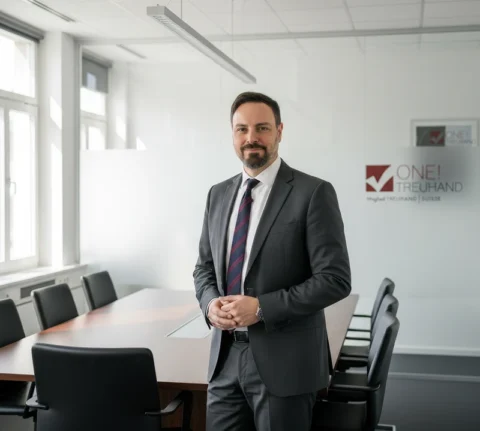
Ein kompetenter Steuerberater steht in einem modern eingerichteten Treuhand-Büro, bereit für mandantenorientierte Beratung.

Rodolfo Intaglietta EN

Rodolfo Intaglietta is the founder and managing director of ONE! Treuhand GmbH. As a Treuhänder mit eidg. Fachausweis (Swiss federally certified trustee) and a Diplomierter Experte in Rechnungslegung und Controlling (certified expert in accounting and controlling), he supports entrepreneurs across Switzerland with clear financial insights, digital processes, and personal, hands-on advisory services.

The qualification “eidg. diplomierter Experte in Rechnungslegung und Controlling” corresponds to NQF level 8, the highest level of formal education in Switzerland, and is comparable to a doctoral degree in terms of depth of expertise and level of responsibility.