WhatsApp

+41445333425

Telefon

+41 (0) 44 533 34 25

Email

welcome@onetreuhand.ch

+41 (0) 44 533 34 25

welcome@onetreuhand.ch

×

Optimal Tax Strategies for Companies in Switzerland

A well-designed tax strategy helps companies optimise their tax burden, plan investments effectively, and remain competitive in the long term.

19.01.2026 von Rodolfo Intaglietta EN
Letzte Aktualisierung: 28.01.2026
instructions
Advanced
10 Min

Summary

Switzerland offers attractive tax conditions for companies at federal, cantonal, and municipal levels. Structured tax planning helps reduce risks and unlock financial advantages. A forward-looking strategy strengthens stability, liquidity, and sustainable growth.

What you will learn:

  • Structure and key features of the Swiss tax system
  • Importance of strategic tax planning for companies
  • National and international tax strategies
  • Use of deductions, incentives, and support schemes
  • Interaction between accounting, location choice, and taxation

Required skilllevel

Advanced necessary

Required Tools

  • Accurate and up-to-date accounting
  • Overview of legal form, shareholdings, and investments
  • Documentation for R&D, sustainability, and digital projects
  • Regular tax and financial reports

Overview of the Swiss Tax System

Switzerland has a federal tax system with three levels: federal, cantonal, and municipal. Each level levies its own taxes and applies different tax rates. As a result, tax burdens can vary significantly depending on location, making location-specific tax planning essential.

 
Importance of Strategic Tax Planning

Forward-looking tax planning helps companies manage their tax burden over the long term and reduce financial risks. It enables the targeted use of tax incentives, improves investment planning, and supports stable liquidity management. It also allows companies to react efficiently to legislative changes.

 
Tax Strategies for Companies in Switzerland

Switzerland offers comparatively low corporate tax rates and a business-friendly environment. These advantages are complemented by targeted incentives, particularly for research, development, and innovation. Cantonal differences can also be used strategically.


Choice of Legal Form

The legal form of a company has direct tax implications. Public limited companies and limited liability companies offer different advantages in terms of profit taxation, capital raising, and dividend distribution. Sole proprietorships are simpler in structure but require careful tax consideration.


International Tax Strategies

Double taxation agreements help companies structure international income efficiently. Proper transfer pricing is essential to minimise tax risks. International tax strategies require continuous monitoring and adaptation to regulatory changes.


Research, Development, and Innovation

Investments in research and development are tax-favoured in Switzerland. Companies can claim deductions for R&D expenses and benefit from additional support programmes. This strengthens innovation capacity and competitiveness.


Use of Tax Deductions and Credits

Operating expenses, investments, and certain training or marketing costs may be tax deductible. Depreciation spreads investments over several years and reduces ongoing tax burdens. Proper and complete documentation is essential.


Real Estate and Location Strategy

Real estate ownership can be tax-optimised through depreciation and deductions for maintenance. The choice of canton plays a key role, as tax rates and incentive schemes differ widely.


Holding Structures and Capital Planning

Holding companies can provide tax advantages for dividends and capital gains. Capital structure decisions—equity versus debt—also influence taxation through interest deductions or profit taxation.

 
Accounting, Reporting, and Tax Pitfalls

Proper accounting is the foundation for tax reporting and annual financial statements. Common pitfalls include inadequate documentation, missed deductions, or incorrect transfer pricing. Regular reviews of tax strategies reduce risks.


Human Resources and Digital Transformation

Tax-optimised compensation models and employee benefits can reduce payroll costs and improve employer attractiveness. At the same time, digital transformation creates new tax requirements and funding opportunities.


Succession Planning, Mergers, and Acquisitions

Business succession, mergers, and acquisitions require early tax analysis. Structured planning helps reduce tax burdens during transfers or integrations and ensures long-term stability.


Sustainability and Tax Incentives

Sustainable investments are supported by tax incentives. Companies investing in renewable energy or environmentally friendly technologies can achieve both ecological and tax benefits.
FAQ

How can a company find the best canton for its location?

By comparing cantonal tax rates, incentive programmes, and economic conditions.

Which expenses are tax deductible?

Typical examples include operating expenses, investments, marketing, and training costs.

How can tax back payments be avoided?

Through proactive tax planning, accurate accounting, and regular professional advice.

What is a double taxation agreement?

An agreement that prevents income from being taxed in two different countries.

How do companies benefit from R&D incentives?

Through deductions for development expenses and additional support programmes.

Key Takeaways

  • The Swiss tax system requires differentiated planning
  • Tax strategies secure liquidity and competitiveness
  • Legal form, location, and capital structure influence tax burden
  • R&D, sustainability, and digitalisation offer tax opportunities
  • Accurate accounting is the basis of tax optimisation
  • Proactive planning helps avoid tax pitfalls

Optimal tax strategies are a key success factor for companies in Switzerland. By consciously choosing the legal form, location, and investment strategy, and by making targeted use of tax incentives, companies can achieve significant financial advantages. Forward-looking, well-documented tax planning strengthens stability, competitiveness, and long-term business success.

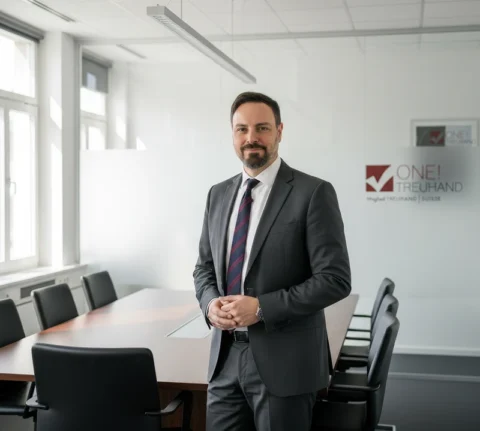
Ein kompetenter Steuerberater steht in einem modern eingerichteten Treuhand-Büro, bereit für mandantenorientierte Beratung.

Rodolfo Intaglietta EN

Rodolfo Intaglietta is the founder and managing director of ONE! Treuhand GmbH. As a Treuhänder mit eidg. Fachausweis (Swiss federally certified trustee) and a Diplomierter Experte in Rechnungslegung und Controlling (certified expert in accounting and controlling), he supports entrepreneurs across Switzerland with clear financial insights, digital processes, and personal, hands-on advisory services.

The qualification “eidg. diplomierter Experte in Rechnungslegung und Controlling” corresponds to NQF level 8, the highest level of formal education in Switzerland, and is comparable to a doctoral degree in terms of depth of expertise and level of responsibility.